Every business owner has wondered, at some point: what is my company actually worth — and what would it take to maximize that value?
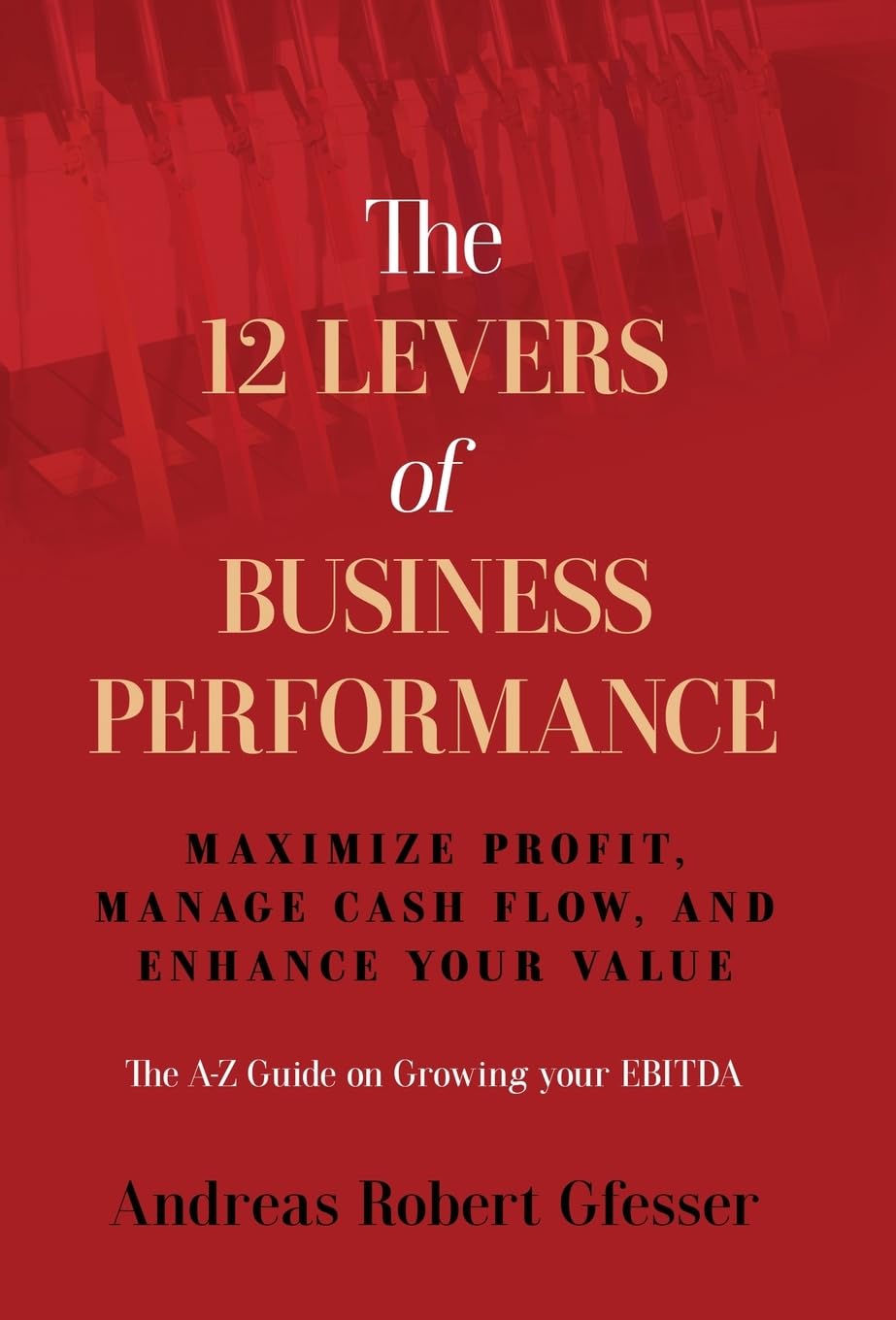
Most advice on that question stays vague. Grow revenue. Cut costs. Hire better people. But what does any of that specifically mean for your bottom line and your exit price? Andreas Gfesser’s The 12 Levers of Business Performance: Maximize Profit, Manage Cash Flow, and Enhance Your Value answers that question with remarkable precision.
Gfesser, President of Crossroads, Consulting Division of Trendler, Inc., has spent more than three decades in the trenches of manufacturing and business consulting. His book distills that experience into a structured, actionable framework that any business owner can pick up and immediately put to work.
A Compass for Business Owners Ready to Get Serious About Value
At its core, The 12 Levers of Business Performance is a guide to mastering EBITDA, Earnings Before Interest, Taxes, Depreciation, and Amortization, the metric that investors and acquirers use to determine what a business is truly worth. Rather than offering a dry finance lecture, Gfesser uses the relatable journey of a fictional CEO named Bob to walk readers through each concept, making the material accessible even for owners without a finance background.
“Growth is not the same as value. Value is built by intentionally managing the key levers that drive results: across operations, finance, and strategy.”
The book is structured around three core deliverables: the 12 Value Levers themselves, the Closed-Loop Value Enhancement Process for continuous improvement, and a personalized EBITDA Integration Strategy that maps a company’s history and charts its path forward.
Whether you’re preparing to sell, trying to attract investment, or simply want to build a healthier operation, this book gives you the blueprint.
The 12 Value Levers Explained
Gfesser organizes performance improvement across four interconnected domains: financial health, operational efficiency, strategic positioning, and leadership. Together, the 12 levers form a comprehensive diagnostic and action framework.
01 Revenue Growth
Sustainable top-line expansion through market penetration and pricing discipline
02 Gross Margin Improvement
Strengthening the spread between revenue and direct cost of delivery
03 Operating Expense Control
Scrutinizing overhead without sacrificing capability or culture
04 Cash Flow Management
Converting profit into real cash — receivables, inventory turns, working capital
05 Customer Concentration Risk
Reducing dependency on any single client and broadening the revenue base
06 Recurring Revenue
Building predictable, contractual income streams valued by acquirers
07 Operational Systems & Processes
Documenting how work gets done so the business runs without the owner
08 Team & Talent Development
Building a leadership bench that executes strategy independently
09 Strategic Planning
A clear, documented roadmap that builds stakeholder confidence
10 Market Differentiation
A defensible value proposition that justifies premium pricing
11 Technology & Innovation
Leveraging modern tools to drive efficiency and competitive advantage
12 Owner Independence
Transferability — the degree to which the business thrives without the current owner
What makes the framework especially practical is its emphasis on the interplay between levers. A company might chase revenue growth aggressively while neglecting cash flow management, only to find itself profitable on paper but dangerously short on liquidity. The book teaches owners to think in systems, not in isolation.
What Business Owners Will Walk Away With
Beyond the framework itself, the book is packed with mindset shifts and practical tools that challenge the way many owners think about their companies.
Core lessons from the book:
→ EBITDA isn’t just an accounting term, it’s the language of value, and every operational decision either adds to it or erodes it
→ Growth and profitability are not the same thing. Many fast-growing companies destroy value in the process
→ Investors and acquirers think very differently from operators. Learning to see your business through their eyes is one of the most valuable shifts an owner can make
→ The Closed-Loop Value Enhancement Process ensures improvements are sustained over time, not just achieved once and lost
→ Owner dependence is one of the largest discounts applied to a business valuation. The more the business runs on the owner’s relationships, the less it’s worth to anyone else
→ Your EBITDA Integration Strategy is a living document, equal parts historical narrative and forward-looking roadmap
The fictional CEO Bob serves as a deft narrative device throughout. Readers follow his journey from confusion and overwhelm to clarity and command, seeing their own businesses reflected back in an honest and constructive way.
Especially Relevant for Manufacturers and Small-to-Mid-Sized Businesses
35+ Years of executive leadership experience Gfesser brings to the framework
12 Discrete levers that together form a complete picture of enterprise value
1 Integrated EBITDA Integration Strategy tying every lever together
Gfesser’s consulting work has been concentrated in manufacturing and hospitality, sectors where owners often have deep operational expertise but less familiarity with how strategic decisions affect market value. This book speaks directly to that gap.
For a small or mid-sized manufacturer, the levers around operational systems, team independence, and customer concentration risk are particularly consequential. A business that runs without the founder, serves a diversified customer base, and has documented processes commands a materially higher multiple, even if revenue and profits are identical to a less organized competitor.
Is This Book Right for You?
This book is for you if…
→ You own a small to mid-sized business and have never thought systematically about how its value is calculated
→ You’re planning a business exit, whether in 2 years or 10, and want to ensure you receive the maximum possible price
→ You’re looking to attract outside investors and need to present your business in the language they speak
→ Your business is profitable but cash-strapped, and you want to understand why those two things can coexist
→ You feel the business depends too heavily on you personally and want a roadmap for changing that
→ You’re a CEO, COO, or senior leader who wants a shared language and framework for driving performance across the organization
The writing is accessible rather than academic, and Gfesser’s practitioner background ensures every concept is grounded in real-world application. This is a book you can read cover to cover, then return to chapter by chapter as a working reference.
Andreas Gfesser: A Practitioner’s Perspective
Gfesser’s credibility comes not from academia but from decades of doing the work himself. As a former CEO in the commercial furniture manufacturing sector, the same industry Trendler has served since its founding, he understands the specific pressures and opportunities that owners of product-based, manufacturing-intensive businesses face.
Andreas Gfesser
President, Crossroads Consulting Division · Trendler, Inc.
A nationally recognized strategic consultant, former CEO, and industry innovator with over 30 years of executive leadership experience in the commercial furniture manufacturing sector. Founder of Crossroads Business Partners and Crossroads Hospitality, specializing in catalyzing growth, guiding executive teams, and modernizing operations for small and mid-sized manufacturers.
His dual role as both a strategist and a tactician is evident in every chapter. The 12 Levers framework wasn’t developed in a classroom; it was refined over decades of working alongside business owners in real situations with real stakes.
A Framework That Works Whether You’re Ready to Sell or Just Getting Started
One of the most refreshing aspects of The 12 Levers of Business Performance is its refusal to be a book only for exit planning. The levers Gfesser describes are the same ones that make a business more profitable, more cash-generative, and more resilient over the long term, regardless of whether a sale is on the horizon.
In other words: the best time to start pulling these levers is now, not six months before you list the business. The owners who achieve the highest valuations are typically those who have been thinking like an investor for years before any transaction ever happens.
“Your journey to maximizing EBITDA value begins here — whether you want to sell, attract investors, or simply build a better business.”
For any business owner serious about understanding and improving the financial and strategic health of their company, this book belongs on the desk, not the shelf.
READY TO TAKE THE NEXT STEP?
Work With the Team Behind the Framework
Andreas Gfesser and the Crossroads Consulting Division at Trendler, Inc. are available to help you apply the 12 Levers directly to your business — from initial assessment through strategic implementation.
Visit Trendler, Inc. → trendler.com